The Anti-Journeyer: Daphne Refuses the Call
When adventure calls, Daphne's "ghosts" keep her from answering
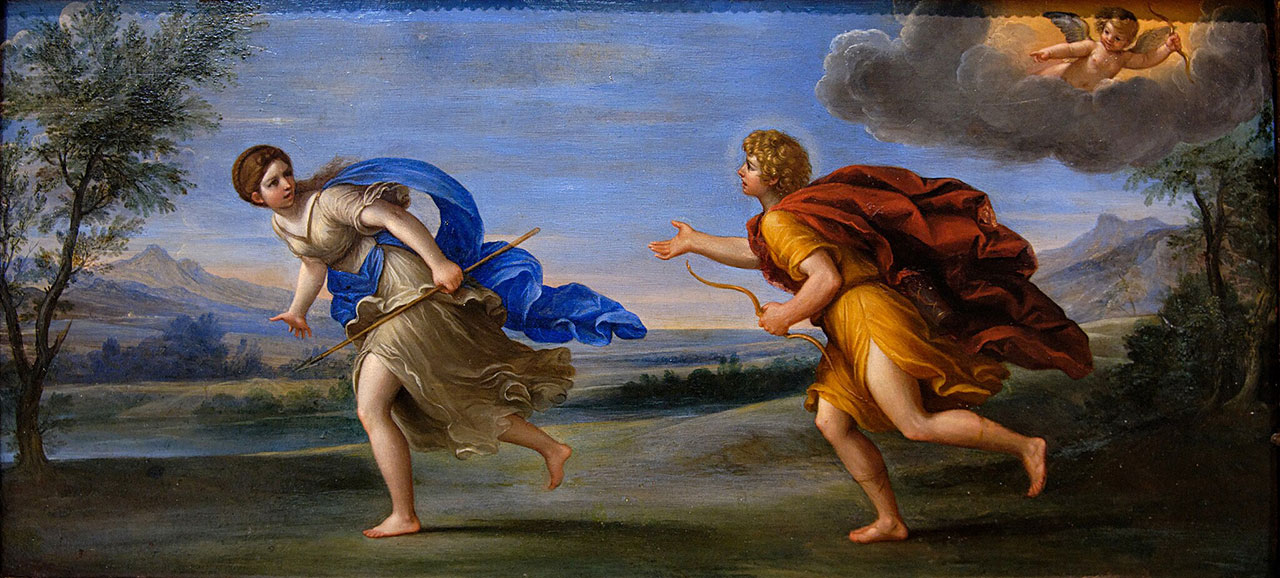
In my post on Penelope’s path, I mentioned a character whom Kim Hudson refers to as the “anti-Virgin,” because this character is taking an inverse version of the Virgin’s Promise Journey (which I call Penelope’s Path, on account of Penelope of the Odyssey being an archetypal example). The anti-Virgin, said I, prefers to build a cage for herself, in which she or he does not grow, and stays small. An anti-Jane Eyre, for whom no net ensares, savvy?
The anti-Virgin Journey’s central idea is that the Journeyer is resisting going on the Journey, and their community is trying to convince them to go.
Why does it matter if they take the journey?
In case this is a serious question, let’s go back to the Hero’s Journey. The famous Refusal of the Call is often treated as a rote step, a checkbox for beginning writers to check off. But there’s a point to that step, which I’ve alluded to in other posts. As a general rule, a heroic character is unlikely to refuse the call. A character who is going from zero to hero — in other words, not a hero yet — certainly might, because this is a point to grow from.
If a character is already heroic then for narrative purposes another character will try to encourage them to refuse the call. Recall Steve Trevor trying to convince Wonder Woman not to enter No Man’s Land:
… Because no man can cross it. This battalion has been here for nearly a year, and they barely gained an inch. Because on the other side, there are a bunch of Germans pointing machine guns on every square inch of this place.”
But she goes anyway. The narrative purpose, by the way, is to underline the stakes of the story, so that her heroism stands out all the more. And it does matter that Steve, a valiant man himself, is the one warning her not to go. His weakness isn’t lack of courage or willingness to protect the village, but rather he is mortal and not divinely gifted with invincible armor. Thus Wonder Woman is no Mary Sue, who can only look smart if others are stupid, and can only be strong if others are weak. A hero is not defined by other people’s deficiencies.
Remember in the Hero’s Journey it is possible to refuse the call. After all, the Mythic Journeyer is not the personal target of whatever evil is threatening the Hero’s village. And what happens if he or she should refuse to undertake the journey? Tragedy: the village may be destroyed.
In the domestic realm of the Penelope Journeyer it is also possible to refuse the call, which distinguishes it from the other variants of the Fairy-Tale Journeys, aka the Heroine’s Journeys. At one end, the path of King Minos: become a villain. He chooses to not take the leap of faith and grow, because he wants to maintain his status quo at all costs. Poseidon curses him so that the very bull Minos refuses to sacrifice becomes the instrument of his kingdom’s destruction, bringing forth the Minotaur.
At the other end: stagnation. I am naming this end of the refusal spectrum after Daphne, in keeping with my naming theme for these journeys. In The Hero With a Thousand Faces, Joseph Campbell cites the story of Daphne and Apollo. Daphne rejects Apollo’s advances and is turned into a laurel when she pleads for rescue. It’s a boring end. Apollo called, she refused, and she just ends up stuck as a plant, rooted to the spot and going nowhere.

While either end does suggest some interesting seeds for shadow characters — that is, characters who are shadow versions of your protagonists, and serve as an object lesson — at the end of the day if your story embraces this pro-stagnation point of view for the protagonist it’s going to be a lesson in frustration for the reader. No one wants to read about a character who is going nowhere and insists on remaining in that state. You begin every story with a moment of change, per Dwight V. Swain, Techniques of the Selling Writer. You end when that change comes to fruition.
With a character who is more on Daphne’s end than that of Kingo Minos, you get this:
Walled in boredom, hard work, or ‘culture,’ the subject loses the power of significant affirmative action and becomes a victim to be saved. His flowering world becomes a wasteland of dry stones, and his life feels meaningless…
Think of Éowyn, a shield maiden of Rohan who fears growing old and useless without ever having proven her valor in battle. She didn’t want to look back on her youth and mourn what she might have been, or could have done. Even if your protagonist isn’t seeking martial glory as Éowyn, they likely have a potential to do something or be something: an explorer, a parent, a singer, or surgeon.
Here I shall also invoke the Parable of the Talents from the Bible: A plutocrat entrusts three slaves with assorted sums of money (in denomination of talents, which amounts to a human’s weight in gold). Two of them make profitable use of the talents, doubling the amount they started with, but the other one buries it out of fear that he’ll lose that talent rather than gain a profit. The other two are rewarded. The wasteful one is rebuked, as he could have at least put the money in the bank to gain interest, which his master points out to him.
It is built into us to abhor the wasting of potential and opportunities, especially when it comes to one’s life and whether we will die satisfied, or full of regretful sorrow. Perhaps you are here because you have stories inside you that you want to be read in this life, not in the Library of Dreams where Morpheus (the Sandman) collects books never written, only dreamed of.
Like any anti-hero — per the classical definition — an anti-Virgin protagonist is potentially highly unsympathetic, especially when refusing to change, grow, or soar. Quite tedious and annoying for the reader to endure. How, then, to write that character and thread that needle?
The Ghost is the Key
If you’re writing a Daphne who is meant to be sympathetic, the Ghost or Wound in the character’s backstory is going to loom particularly large. The story hinges on how convincingly you can illustrate how the Ghost informs the Daphne’s outlook on themselves and their life. Why does this Journeyer feel compelled to remain small?
This question reminded me of Haibane Renmei, which provides an example of someone who needs to take the Journey, but fears to do so.
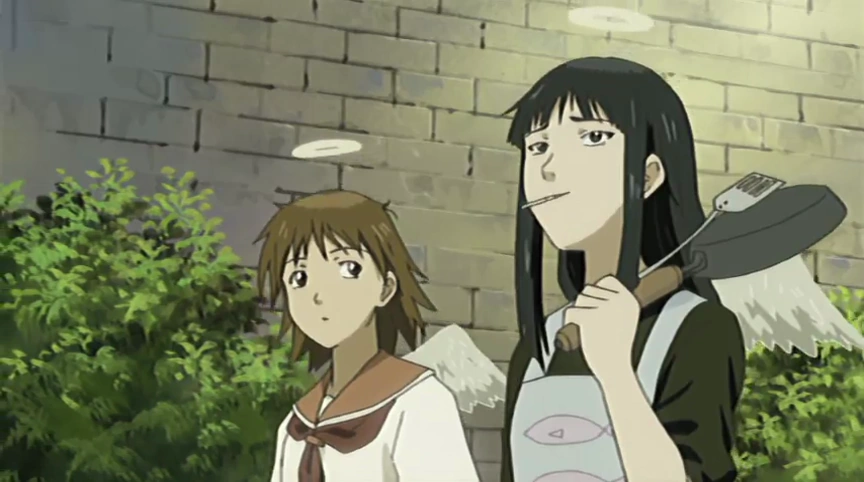
In Haibane, all of the central characters are in the afterlife. It’s made clear in the opening sequence of the first episode that these characters are specifically children who have committed suicide. Their afterlife takes place in a walled city in which the children must learn to face the aspects of their flawed thinking and approaches to life that led to their suicides. They aren’t supposed to grow to adulthood, they’re supposed to “awaken” to understanding themselves and their past mistakes and forgive themselves instead.
If they succeed in their awakening, they get to take their “Day of Flight,” in which they go back to Earth for a second chance, as reincarnated people.
If they fail, they miss their Day of Flight and are exiled beyond the walled city. They will live in isolation, and grow to adulthood until their second death.
An “afterlife with teeth,” as one reviewer put it. So, it matters that Reki, a key character, is “sin bound.” She believes herself beyond redemption, beyond help; in her own mind she’s unworthy of help. As a result she doesn’t ask for help, which is the problem the protagonist, Rakka, must help her overcome. It’s imperative she help Reki, for Reki is on the cusp of adulthood.
The thing is, Reki helps the other children. She protects them, guides them, nurtures them, and helps them reach their own Days of Flight. This is what makes her sympathetic, along with her refusal to whine about her own situation.
This is key: the Daphne must believe there is a reason to stay in the small world instead of spreading her wings. A childhood friend introduced me to this touching song when we were thirteen: “Patches,” by Clarence Carter.
Young Patches has a poor family, and when he’s thirteen he’s obliged to become a man because his father dies. Patches thinks he ought to quit school and go to work to support his family, but his mother refuses to let him because, “That was Daddy’s strictest rule.”
For a Patches, the Journey will not be taken because he believes he’s morally obligated to stay and help his family; for a Reki it’s because she’s convinced she’s unworthy of forgiveness. Something makes the Journeyer feel the Journey can’t or shouldn’t be taken.
Then of course, there’s fear. A fear of change, a fear of being unequal to a particular necessary change could also propel your story’s Daphne. Remember in The King’s Speech the eventual King George VI observes his father, King George V, speaking into a microphone for a radio speech? George V tells his son — who stutters whenever he talks — that the new way of the future is to give radio addresses. Imagine if George VI were the elder brother, and felt so afraid of having to speak in public that he abdicated instead of Edward VIII? Fortunately, as the king he overcame his fear.
In the Mythic and Penelope journeys, parents represent a kind of threshold guardian. The Journeyers must break past these guardians to become their own people. In The Virgin’s Promise, Kim Hudson references the Oedipal complex in relation to the Mythic Journeyer, who must separate from “mother”: “the desire to cling to the comforts of home at the expense of knowing the bigger world …”
Do note there does not need to be a literal mother in this scenario. The point is that the Mythic Journeyer must be prepared to leave home and survive in a hostile world with whatever wits, talents, and allies he or she possesses or can acquire.
In relation to the Penelope Journeyer, Hudson references an Ophelia Complex: a need to please and conform to the values of others — “father” — because the sufferer fears the loss of love and security the “father” provides. Again, there does not need to be a literal father in this scenario:
Each time a social organization places someone at odds with their true nature, the Virgin archetype provides guidance towards becoming authentic. Any time something valued is threatened, the Hero archetype may rise to save it.
A Daphne clings hard to authority figures. When fleeing Apollo, Daphne calls out to her father, a river god, to change her into something else so she does not have to face Apollo. To grasp the implications better, think of a mama’s boy, a mammoni who will not cut the apron strings and insists on remaining unnaturally dependent upon Mama.
The Penelope Journeyer is supposed to form her own values and stay true to them, and unshackle herself from dependence.
In the Cleopatra’s Daughter trilogy by Stephanie Dray, Julia, the daughter of Augustus, is an Ophelia. She longs for his approval, bending to his will for a scrap of praise, and unable to see he is unworthy of her loyalty (specifically as he’s written in the trilogy). Though the trilogy ends before she meets her final fate, history lovers know it was not a happy one, and the path to it was one of disaster and ruin.
Not All Who Hesitate Are Lost
This is Campbell’s observation in the “Refusal of the Call” chapter, and he points to a few stories where the hesitation turns out to lead to “providential revelation,” as in the case of Briar-Rose (Sleeping Beauty) and Brynhild. This type of refusal may be rooted in an insistence on holding out for the “deepest, highest, richest answer to the as-yet-unknown demand of some waiting void within.” And even that kind of refusal may have consequences that require a miracle to overcome …
I point this out only to make clear that even if your protagonist is a Daphne, he or she will not be “lost” necessarily. It could be that a Daphne will Answer the Call if something in her soul is finally touched by that call. Patches might not leave the family farm to get a “pointless college degree” when he’s got mouths to feed. But he might go if he has an aptitude for medicine and is offered a scholarship to study it, and potentially find a cure for whatever ailment killed his father.
At any rate, if you are writing an anti-Penelope, the key here is to give her a compelling reason to firmly root herself within the Dependent World.